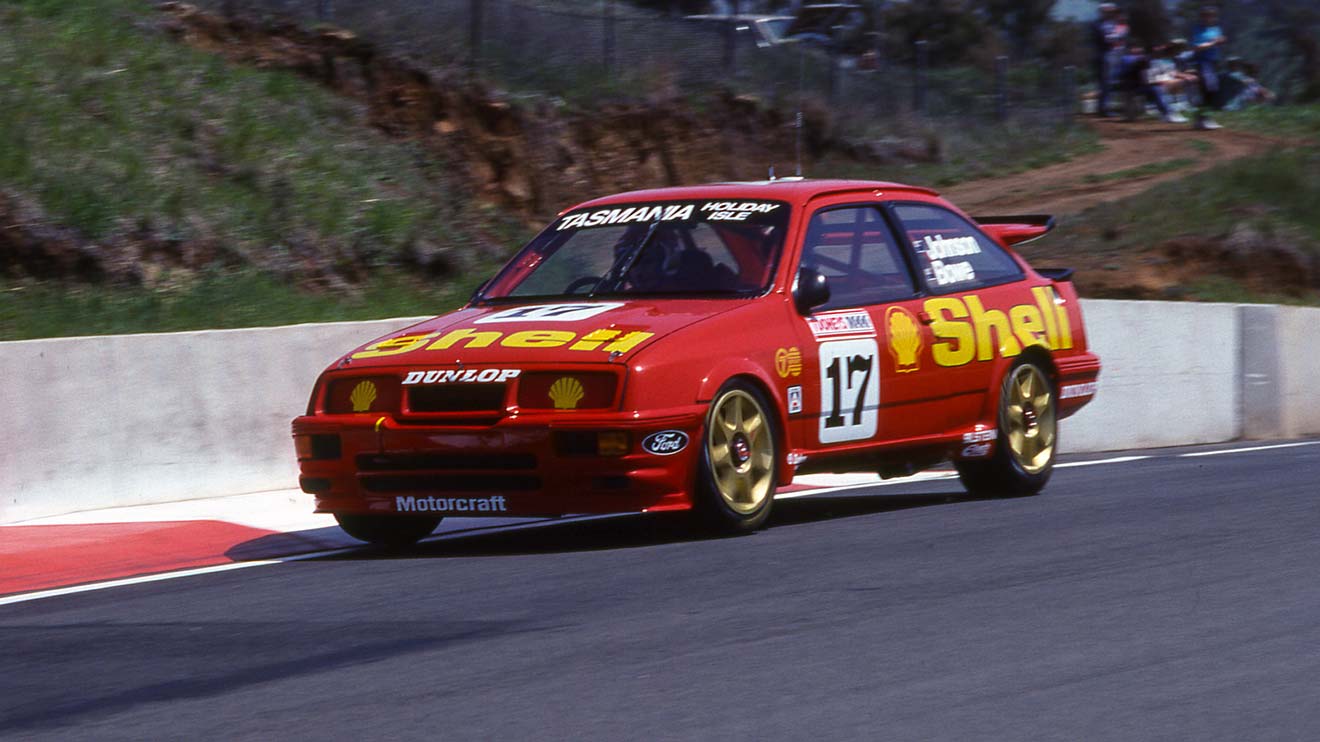
Looking Back is a new regular feature by Will Dale, telling the stories, the successes, the trials and the tribulations of a racing life now in its seventh decade and a team deep into its fifth. Dick Johnson might never look back. Lucky for all of us, Will does.
THERE’S an old saying about being ‘only as good as your last race’. In that respect, Dick Johnson Racing’s Ford Sierras ended their time at the Bathurst 1000 as the best of their breed.
The 1992 event didn’t end with the precious Waterford Crystal trophy heading back to Queensland, but an emphatic Top 10 Shootout pole position for Dick Johnson followed a day later by a stirring run to second for he and John Bowe illustrated that the Shell cars were once again the pick of Ford’s turbocharged rockets.
The same couldn’t have been said 12 months earlier.
DJR’s Sierras had been the benchmark at the close of the 1980s, a reputation forged by a slew of race wins, a pair of championship titles and a ‘Great Race’ triumph in 1989.
But a new apex predator arrived in 1990: Nissan’s four-wheel-drive, twin-turbo GT-R. No other Group A challenger could hold a candle to the technologically advanced machine, and the wins for Johnson’s squad dried up.
However, the red cars weren’t the Nissans’ nearest challenger, either. The team had slipped from its perch as both the pick of the field and the best of the ‘Blue Oval’ brigade.
The low point was the 1991 Bathurst 1000.
Along with the traditional #17 and #18 entries, the team entered a third car under #19 for young Kiwi racers Kayne Scott and Gregg Taylor. But the Shell cars took a back seat to Glenn Seton’s lead Sierra in qualifying and the Top 10.
Worse still, the red cars kept detonating engines during the lead-up. Both #17 and #18 did so early in Wednesday’s opening practice, and again during Friday. The trigger was a mysterious electronic glitch that randomly advanced the timing on one cylinder. It was an issue which the team was unable to trace prior to the race.
None of the team’s three cars made the chequered flag; Johnson and Bowe looked on course for second place – first in class behind the runaway GT-R – when #17 expired in the final stint, while #18 broke down with only a handful of laps to go.
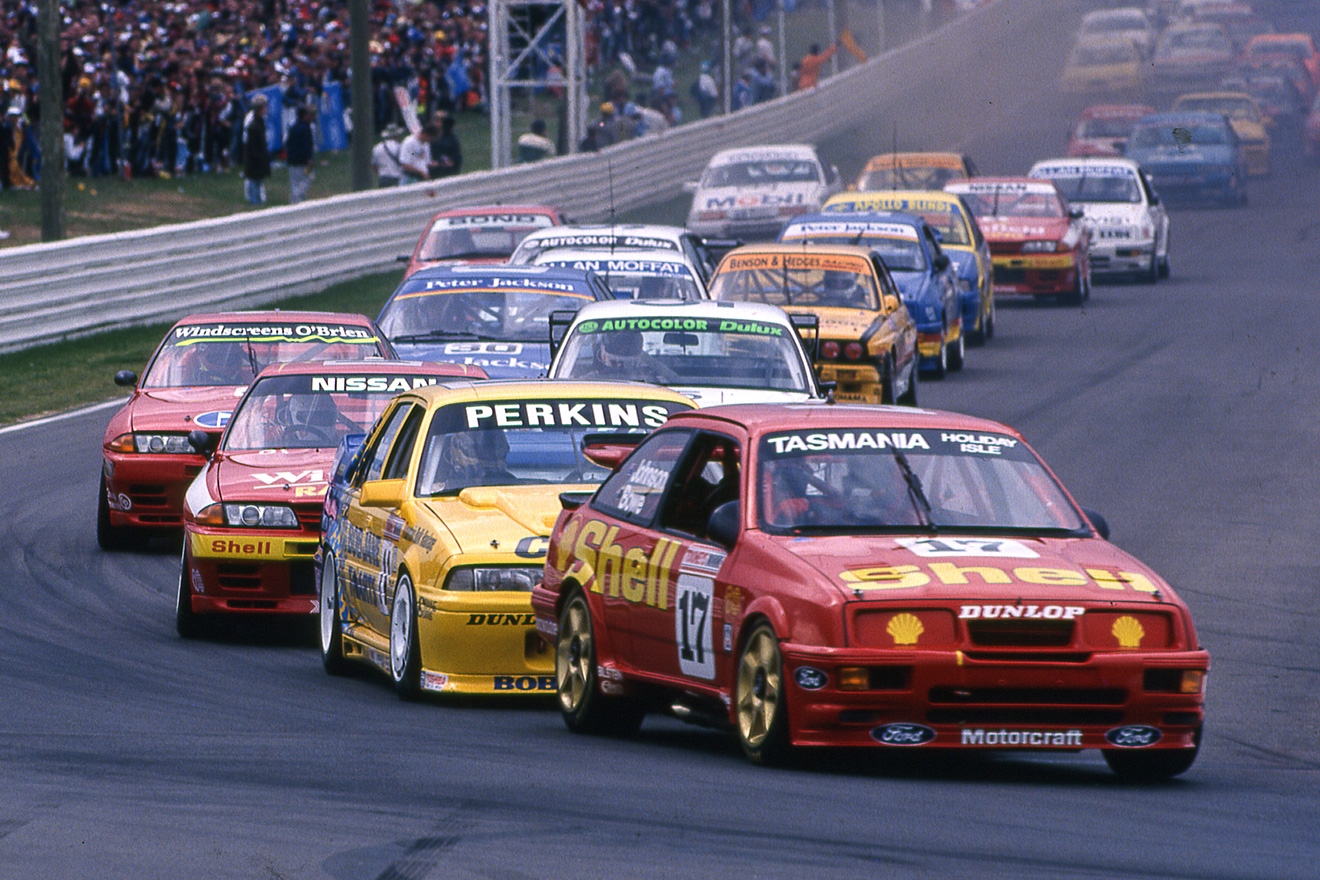
There were big changes for 1992.
First, the regulations were changes to a ‘balance of performance’ style parity process, in which rulemakers used weight, turbo boost limits and rev limits to try and equalise the performance of the Ford, Nissan, BMW M3 and Holden Commodore.
The other was the arrival of Ross Stone.
With Neal Lowe, the Kiwi that headed DJR through its Sierra glory years, building the team’s first EB Falcon ahead of the sport’s switch to V8s for 1993, Stone took charge of the Sierra program for Group A’s last hurrah.
The turnaround was almost immediate. Johnson and Bowe both fought for poles and wins during the ’92 championship season, then started the Sandown 500 from the prime starting position.
The big target was Bathurst, where the #17 Sierra ended regular qualifying in third place courtesy of Bowe.
Johnson took the helm of #17 for the Top 10 Shootout on Saturday morning, and he didn’t disappoint.
He stopped the clocks at a stunning 2m12.898s, the fastest ever lap for a Sierra around Mount Panorama and more than 1.5s quicker than anyone else in the one-lap session to seal his second ‘Great Race’ pole position.
Race day proved bittersweet, however.
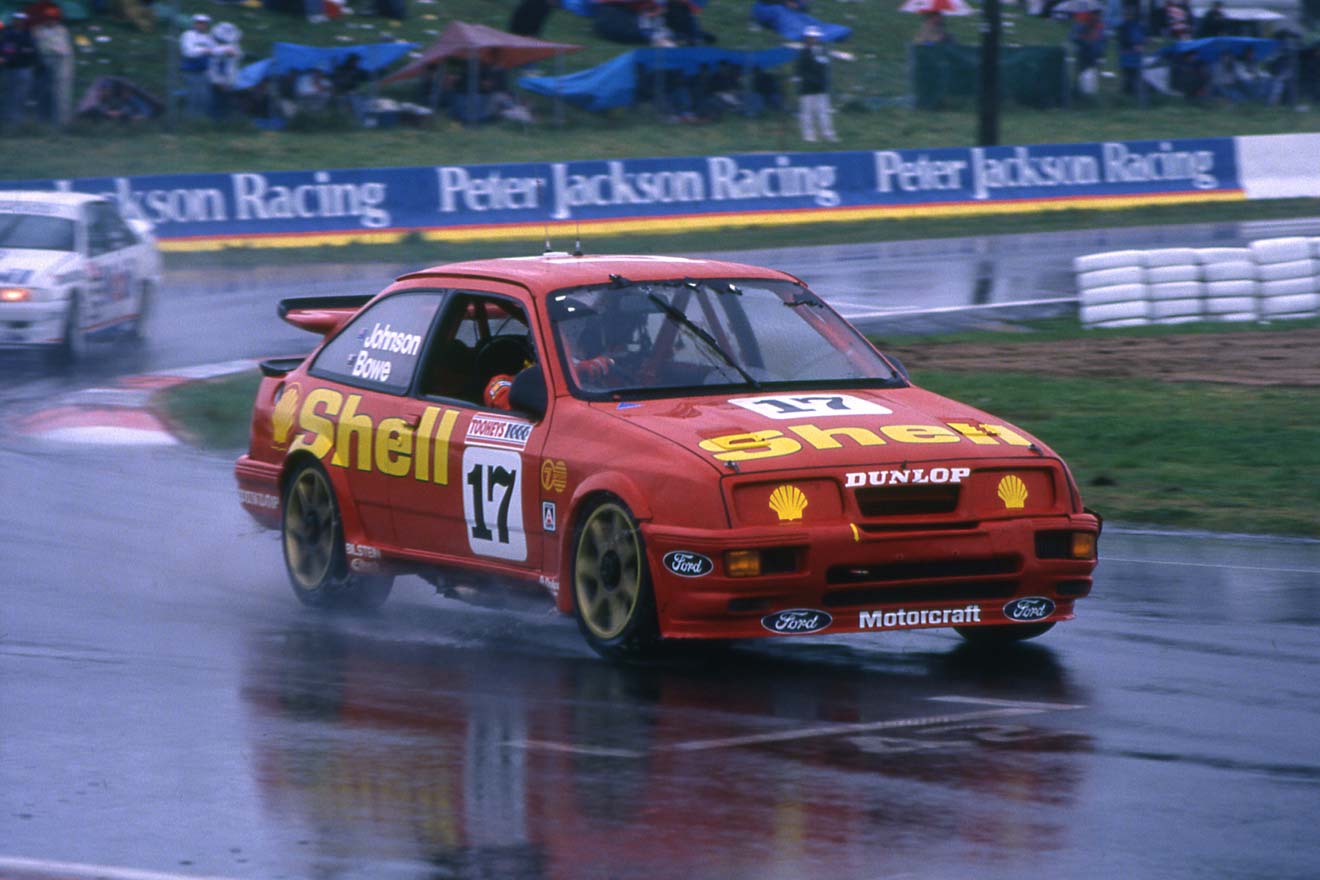
Wet conditions played to the GT-R’s four-wheel-drive strength, but Johnson and Bowe were still the lead Nissan’s closest pursuer – until a sudden storm with 17 laps to go caused chaos.
History shows that the Shell Sierra pitted for wets as the skies burst, but the lead GT-R was stuck out on slicks and crashed twice while crawling back to the pits.
That should have secured the perfect Bathurst Sierra swansong for Johnson and Bowe, but a myriad of other crashes prompted the race to be red-flagged and not restarted, with a countback of laps elevating the Nissan to the victory and demoting the #17 Sierra to second place.
While they famously, in Johnson’s words, were “beaten by a crashed car”, the team’s rebound from 12 months prior re-emphasised that DJR’s Sierras were second to none.
Got a story you’d like to hear? A topic you’d like explored? A race or car you want to know more about? Email will@djr.com.au and it might just become a future feature story on Looking Back.